Are small businesses really targets for hackers?
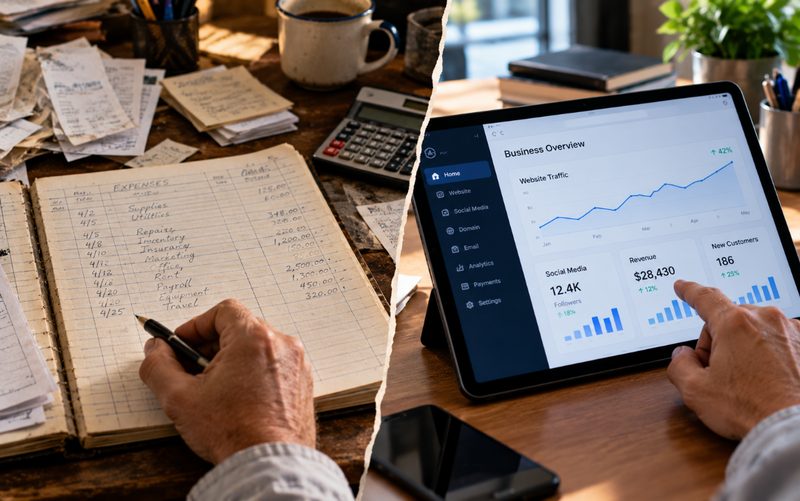
October is Cybersecurity Awareness Month, and I want to start with the one belief that puts more small businesses at risk than any piece of missing software: “Why would anyone bother with us?”
It’s an understandable thought. You’re not a bank. You’re not a household-name retailer. You run a shop, an office, a practice, a crew. Surely hackers have bigger fish to fry. It’s a belief shared by business owners everywhere, including here in Putnam County, from Carmel and Kent to Mahopac and Brewster.
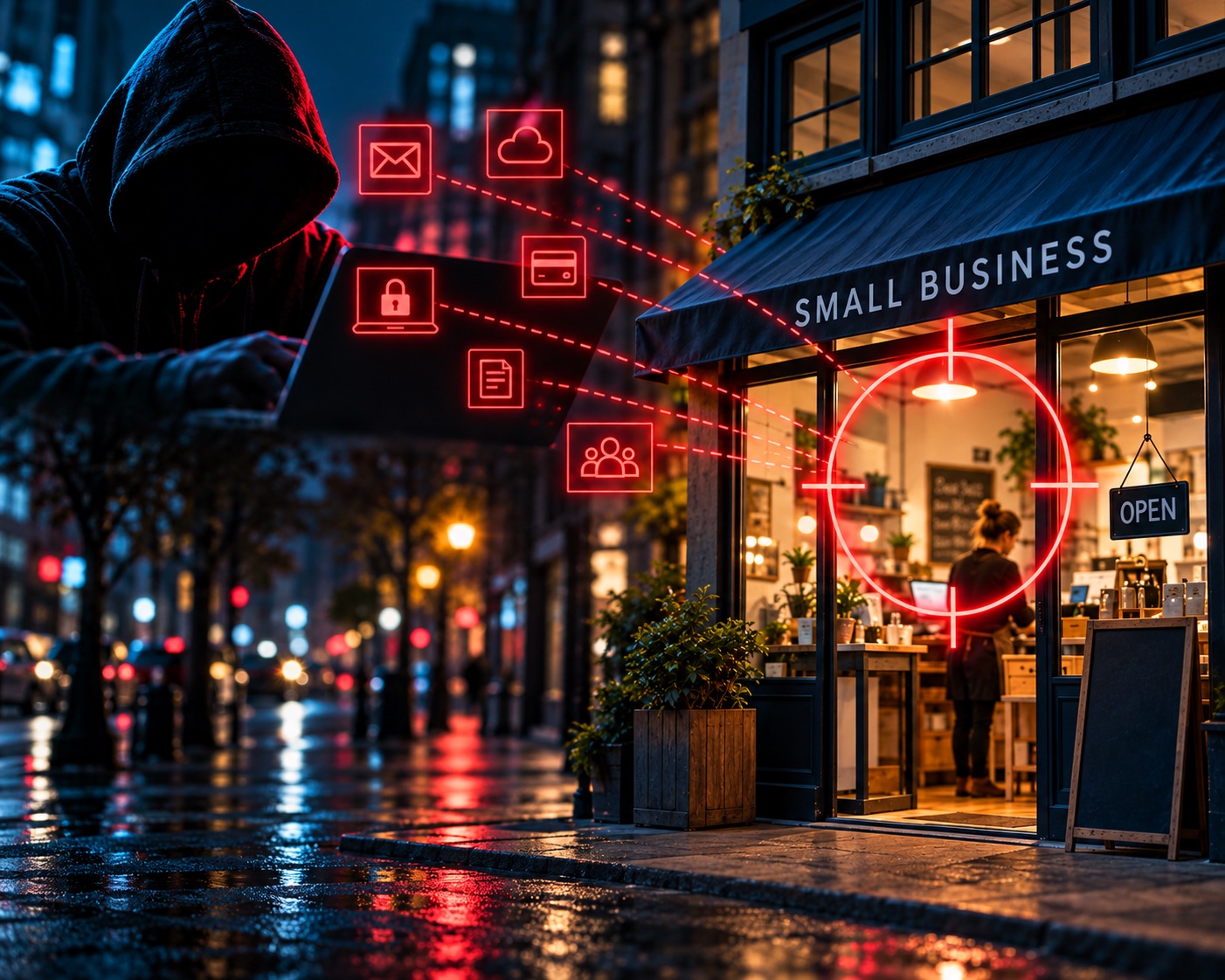
The uncomfortable truth is the opposite. Small businesses aren’t overlooked. They’re increasingly the preferred target. And the reason has less to do with what you have than with what you don’t.
Why do hackers target small businesses?
Large companies have spent years building walls: security teams, monitoring around the clock, strict login rules, and budgets to match. Breaking into them takes time and skill.
Most small businesses are running on something very different. A shared password for the office Wi-Fi, if there’s a password at all. A router nobody has touched since it was installed. Email with no second step to log in. A laptop that “does updates eventually.” Nobody whose job it is to notice when something looks off. Even worse, everyone shares one computer, the same one employees use to check personal email and buy concert tickets.
That difference is the security gap, and attackers know exactly where it is.
The 2026 Verizon Data Breach Investigations Report makes the point plainly: small businesses face the same kinds of attacks as everyone else, and most of those attacks are opportunistic. Attackers aren’t choosing victims by industry or revenue. They’re choosing whoever left a door open, most often through stolen passwords or equipment that was never updated.
“You don’t have to be interesting or the wealthiest to be a target. You just have to be easier than the next business.
In other words
What are hackers after in a small business?
When people picture a hack, they imagine someone stealing a giant pile of data. For a small business, the goal is usually simpler and more direct:
A fake invoice, a changed bank account number, a payment rerouted to the wrong place.
One employee’s email login can open the door to everything else: files, customer records, vendor accounts, even your bank.
Ransomware locks up your computers and files until you pay to get them back.
Once inside your email, an attacker can send convincing messages to the people who already trust you. Your business becomes the bait for the next victim.
That last point matters more than most owners realize. Attacks that travel through vendors and partners are growing fast. Verizon found that breaches involving a third party now make up nearly half of all breaches, up from about 30% a year earlier. Even if you think you have nothing worth stealing, you are connected to people who do.
Why are cyberattacks on small businesses increasing?
A few years ago, going after a small business took real effort for a small payoff. That math has changed.
Attackers now use automation and AI to do the work for them. According to the 2026 Verizon report, criminals are increasingly using AI to run their operations and find vulnerable organizations at scale. A single attacker can scan thousands of businesses overnight looking for an outdated router or a reused password, and write phishing messages that read like they came from your actual vendor, bank, or coworker.
The scams are also moving off email. Verizon reports that phishing by text message and phone call succeeded about 40% more often in simulations than email phishing. Many of us have learned to be suspicious of a strange email. Far fewer of us second-guess a text that looks like it’s from our bank.
When attacks cost almost nothing to launch, it no longer matters that each small business is a small prize. Attackers simply go after all of them.
In the 2026 Verizon report, small organizations made up 96% of ransomware victims.
What does a cyberattack cost a small business?
For a large company, an attack is a bad quarter. For a small business, it can mean days or weeks without access to your files, your scheduling, your invoicing, or your email. It means calls to customers explaining what happened. It can mean paying a ransom with no guarantee you get anything back. It can cost you your customers’ trust, and the financial loss can close your doors for good.
And it often starts quietly. Verizon found that among ransomware victims whose passwords had been stolen first, half had those credentials taken within about three months of the attack. A small slip, like a login typed into the wrong page or an infected personal device, can sit unnoticed until it turns into a full shutdown.
The encouraging part: most small businesses that got hit and refused to pay were able to do so because they had reliable backups. Preparation doesn’t just lower the odds of an attack. It changes how the story ends.
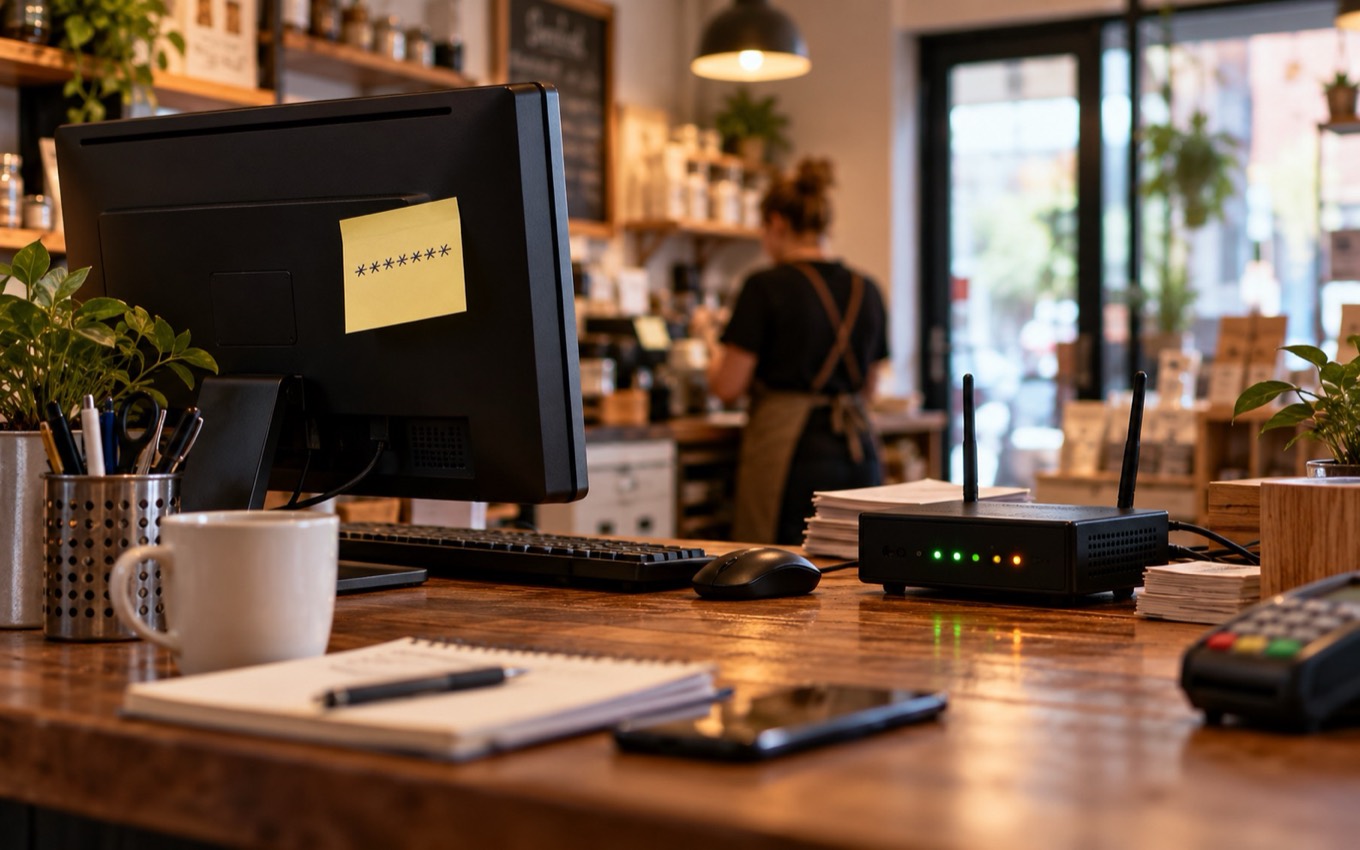
The security gap usually looks this ordinary.
How can a small business close the security gap?
You don’t need an enterprise security budget to stop being the easy target. A handful of basics close most of the doors attackers walk through:
Close the doors attackers walk through
ChecklistThroughout Cybersecurity Awareness Month, I’ll be breaking these down one at a time, starting with the most common way in: phishing, what it looks like, and how not to fall for it.
Attackers aren’t looking for the biggest business. They’re looking for the easiest one. Let’s make sure that isn’t yours.
Frequently asked questions
Why do hackers target small businesses?
+
Small businesses face the same attacks as large companies but usually have fewer defenses, such as multi-factor authentication, updated equipment, or someone monitoring for problems. Most attacks are opportunistic, so attackers go after whichever business is easiest to get into.
What is the most common cyberattack on small businesses?
+
Phishing is the most common way in, through emails, text messages, and phone calls that trick someone into sharing a password or sending money. Ransomware is the most damaging, and small organizations made up 96% of ransomware victims in the 2026 Verizon report.
What is the first step to protect a small business from cyberattacks?
+
Turn on multi-factor authentication for email, banking, and business software. It adds a second step to logging in, so a stolen password alone isn’t enough to get in.
Can a small business recover from a ransomware attack?
+
Yes, especially with reliable backups. Most small businesses that refused to pay a ransom in 2026 were able to do so because they could restore their data from backups.

About the author
Victoria Bonilla is co-founder of PointTech Pros, a technology services company serving small businesses in Carmel, Kent, Mahopac and Brewster, New York.
Sources
- 2026 Verizon Data Breach Investigations Report
- Summary of the 2026 Verizon DBIR for small businesses, Cyber Readiness Institute