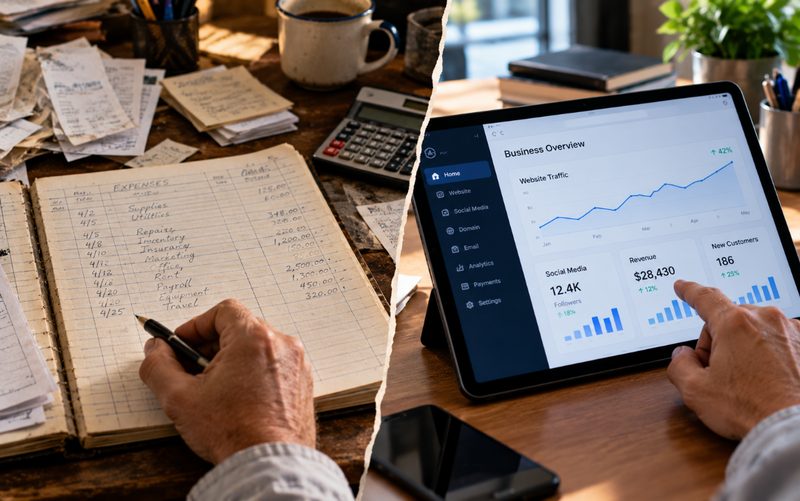

Small businesses run on rhythm. You know your customers, your workflow, your tools, and the way your day usually goes. You have habits that keep things moving, and you rely on them because they work. So when someone brings up modernization, it does not always feel helpful. It can feel like one more thing added to an already full day. Many owners assume modernization means a full overhaul, but it rarely does. Most of the time it is one small update that removes friction instead of adding it. The businesses that grow and stay strong do not change through big dramatic overhauls. They change through small updates over time. Small improvements stack, and a dozen tiny updates can transform a business more than one major change ever could. Not overnight. Not all at once. Just by staying open to the next step.
Most businesses do not fail because the market changed. They fail because they did not change with it. Customer expectations shift. Technology evolves every year. AI is reshaping how people shop, ship, communicate, and pay, and it is moving faster than anything we have seen before. None of that is the real threat. The real threat is the sentence every owner has said at least once: “This is how we have always done it.” It feels safe. It is actually the most expensive sentence in business.
“This is how we have always done it.
The most expensive sentence in business
Even the giants had to modernize
Modernization is not only a small business challenge. Even the largest companies have had to evolve, and plenty did not. Blockbuster ignored streaming and passed on buying Netflix. AOL held on to dialup while the world moved on. Sears missed ecommerce. Tower Records brushed off digital music. These companies did not fail because they lacked resources. They failed because they resisted change. Small businesses fall into the same pattern every day, not because they lack talent or heart, but because they wait too long to update the way they work.

What modernizing actually looks like
Modernizing does not mean replacing everything or learning something complicated. It means updating what no longer serves you, your customers, or the times we are in. Maybe it is a website that helps customers book you. Maybe it is tech tools that cut down repetitive work. Maybe it is AI that handles tasks you do not have time for. Maybe it is a workspace set up for how people work today. These are not disruptions. They are essential maintenance. They are how you keep your business strong.
Owners who make this mindset shift move from protecting what exists to positioning for what is next.
- “Our customers like things the way they are,”
- “We cannot afford to try something new right now,”
- or “Let us wait and see.”
- “What will our customers need a year from now,”
- “What are we losing by not modernizing,”
- or “What is one small upgrade we can test this month.”
Same business. Same people. Same resources. Completely different trajectory.
Start with one step
The businesses that last are not the ones that avoided modernization. They are the ones that got comfortable with it. They stayed curious. They listened. They let go of what worked yesterday so they could build what works tomorrow. Domino’s rebuilt itself with digital ordering and realtime tracking. Netflix leaned into streaming. Best Buy strengthened its digital presence and used its stores to ship online orders faster.
Technology is not replacing small businesses. It is empowering the ones willing to adapt. And if you do not take that step, someone else will. Customers will not wait for you to catch up. They will go to the business down the street with the easier booking process, the faster response, or the website that answers their question at eleven at night. Standing still is not staying safe. It is falling behind.
Modernization does not start with a full overhaul. It starts with one improvement. One tool. One workflow. One upgrade that makes tomorrow easier than today. Real modernization happens through small, practical steps.
Change is coming for every business. The real question is whether you meet it with resistance or readiness.

Common questions
What does modernizing actually mean for a small business?
It rarely means a full overhaul. Most of the time it is one small upgrade that removes friction — a website that takes bookings, a tool that cuts repetitive work, or AI that handles a task you do not have time for.
Do I have to change everything at once?
No. Real modernization happens through small, practical steps — one tool, one workflow at a time. A dozen tiny updates change a business more than one big overhaul ever could.
Is it risky to keep doing things the way we always have?
Standing still is not staying safe. Customers go to the business with the easier booking, the faster response, or the website that answers their question at eleven at night. “This is how we have always done it” is the most expensive sentence in business.
Where should I start?
With one improvement that makes tomorrow easier than today. If you are not sure which step matters most, that is exactly what a free consult is for.